
Whether you are a property manager upgrading an ageing commercial building or a homeowner planning for accessibility, understanding lift installation costs in Australia is essential before you commit to a project. Prices vary significantly based on lift type, building complexity, the number of floors served, and your location. In the Newcastle, Hunter Region, and Central Coast areas, Newcastle Lift Services provides transparent guidance on new installations, helping clients budget with confidence. This guide breaks down the real numbers you can expect in 2026.
Average Lift Installation Costs in Australia
Lift installation cost is not one-size-fits-all. A residential lift is a permanently installed vertical transport system designed for private dwellings. For homes, prices for the lift unit and standard installation typically range from $35,000 to $65,000 AUD, excluding building works and remodelling. When retrofitting is involved, which accounts for the majority of projects, the total cost often climbs to between $60,000 and $100,000 AUD including construction.
For commercial properties, a basic two-level DDA-compliant lift installation starts from approximately $50,000 plus GST. Multi-storey commercial installations with higher capacity and speed requirements can exceed $150,000 depending on specifications.
Key Factors That Influence Installation Cost
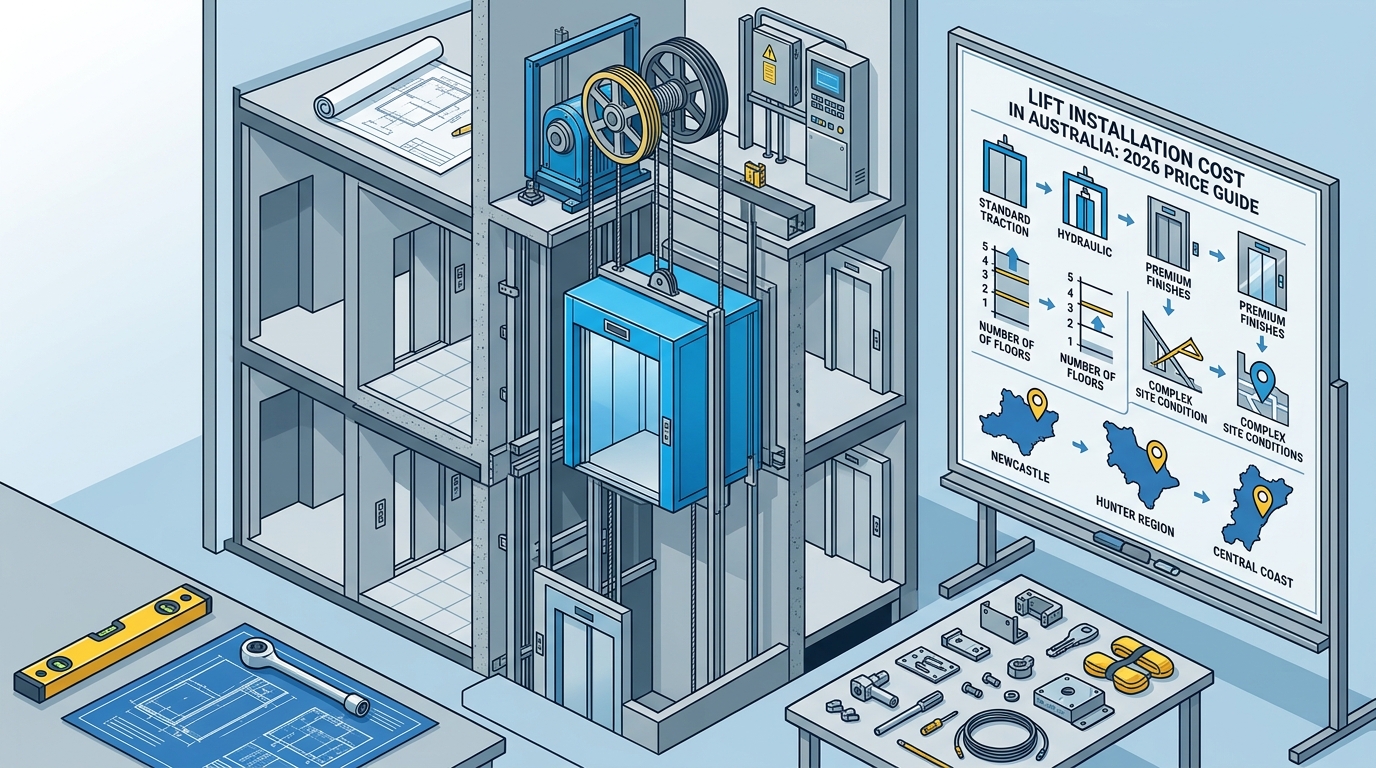
Several variables drive your final price up or down. Understanding these factors helps you set a realistic budget when you request a quote from our team.
Number of Stops and Travel Distance
Each additional floor a lift serves adds roughly $5,000 to $10,000 to the project cost. More stops require longer shafts, extra landing doors, additional wiring, and more complex control systems.
New Build vs Retrofit
Installing a lift during new construction is generally cheaper and less disruptive than retrofitting into an existing building. Retrofitting often demands structural modifications to walls, floors, and access points, which adds $3,000 to $15,000 or more to the budget.
Customisation and Finishes
High-end finishes such as tempered glass walls, hardwood flooring, and custom LED lighting can increase the lift price by 30% to 50%. Standard powder-coated cabins keep costs lower.
Residential vs Commercial Lift Costs
A commercial lift is a heavy-duty vertical transport system engineered to meet DDA accessibility standards and high-frequency usage in public or business premises. The table below compares typical cost ranges for 2026.
| Category | 2-Stop Basic | 3-4 Stop / Mid-Range | Premium / Custom |
|---|---|---|---|
| Residential | $35,000 – $55,000 | $55,000 – $80,000 | $80,000 – $100,000+ |
| Commercial (DDA) | $50,000 – $70,000 | $70,000 – $120,000 | $120,000 – $200,000+ |
Commercial lifts carry higher base costs because all DDA-compliant cabins must meet a minimum internal size of 1,100 mm wide by 1,400 mm deep, and they require more robust safety and fire integration systems.
Cost by Lift Type
The drive system you select has a major impact on your total spend.
Hydraulic Lifts
Hydraulic lifts use fluid pressure to move the cab. They typically cost $40,000 to $60,000 AUD for a residential two-stop system. They are robust and reliable but require a separate machine room and consume more energy than electric alternatives.
Electric Traction Lifts
All-electric traction lifts start from around $42,000 for a basic two-stop model. They are quieter, more energy-efficient, and do not need a separate motor room, making them increasingly popular for both homes and commercial buildings.
Screw-Driven and Pneumatic Lifts
Screw-driven lifts are compact, require no machine room, and suit tight spaces. They start from roughly $31,000 to $40,000. Pneumatic (vacuum) lifts begin at around $69,000 and offer a striking glass-tube aesthetic, though they carry a premium price tag.
Hidden and Ongoing Costs to Budget For
The sticker price of the lift itself is only part of the picture. Smart budgeting requires accounting for the following extras.
- Shaft construction: Building a dedicated lift shaft in an existing structure can cost tens of thousands of dollars depending on design and materials.
- Electrical upgrades: Some lifts need a dedicated circuit or multiphase power supply.
- Council permits and approvals: These typically run between $1,000 and $2,500 in NSW.
- Annual maintenance: Ongoing servicing costs between $500 and $2,500 per year depending on lift type and service agreement. Our lift maintenance programs help you protect your investment long term.
All lift installations in Australia must comply with the AS 1735 series, which covers safety rules, fire-rated landing doors, and emergency braking systems. Non-compliance can void insurance and create serious safety hazards.
How to Save on Your Lift Installation
A lift is a long-term investment, and cutting corners early often leads to higher costs later. Here are practical ways to manage your budget without compromising quality.
- Plan early during construction: Incorporating a lift shaft into new-build plans avoids expensive retrofit work.
- Choose the right technology: Match the drive system to your building type. Screw-driven lifts suit compact residential spaces, while traction systems excel in multi-storey commercial buildings.
- Budget a contingency margin: Allow 20% to 30% extra for unforeseen structural or compliance expenses.
- Work with certified local technicians: Partnering with experienced providers like Newcastle Lift Services ensures proper compliance, better warranty support, and reliable after-sales care.
- Explore funding options: If you are installing a lift for accessibility or medical reasons, you may be eligible for NDIS funding or state-level aged-care grants.
Key Takeaways
- Residential lift installation in Australia typically costs $35,000 to $65,000 for the unit and basic installation in 2026.
- Retrofit projects often push total costs to $60,000 to $100,000 once building works are included.
- Commercial DDA-compliant lifts start from around $50,000 plus GST for a basic two-stop system.
- Each additional floor adds approximately $5,000 to $10,000 to the project cost.
- Annual maintenance ranges from $500 to $2,500 and is essential for safety and warranty compliance.
- All installations must meet AS 1735 Australian safety standards.
- Working with a local, experienced lift company reduces risk and long-term expense.
Frequently Asked Questions
How much does a basic home lift cost in Australia in 2026?
A standard two-stop residential lift typically costs between $35,000 and $65,000 AUD for the unit and installation. This excludes structural modifications, which can add $5,000 to $20,000 or more for retrofits.
What does a commercial lift installation cost?
A basic two-level DDA-compliant commercial lift starts from around $50,000 plus GST. Costs rise with additional floors, higher load capacity, faster speeds, and premium finishes.
What factors affect lift installation price the most?
The number of stops has the largest impact. Other major factors include lift type, new build versus retrofit, cabin size, customisation level, and site-specific structural challenges.
Is it cheaper to install a lift in a new build or retrofit later?
Installing during new construction is almost always cheaper. Retrofitting requires modifications to existing walls, floors, and electrical systems, adding thousands to the total cost.
What ongoing costs should I expect after installation?
Budget for annual maintenance ($500 to $2,500), electricity (minimal, as lifts only draw power during operation), and periodic compliance inspections as required under Australian standards.
Do I need council approval to install a lift in NSW?
In most cases, yes. Local councils assess whether the project qualifies as exempt development or requires formal development approval. Permit costs typically sit between $1,000 and $2,500.
Can I get financial assistance for a lift installation?
If you are installing for accessibility or medical reasons, NDIS funding and state-level aged-care or disability grants may be available. Consult your occupational therapist or local council for eligibility details.
How long does a lift installation take?
A straightforward residential installation can be completed within a few weeks to a month once the site is prepared. Complex commercial projects or major retrofits may take several months.
Get a Tailored Lift Installation Quote
Every building is different, and the only way to get an accurate price is through a professional site assessment. Newcastle Lift Services provides obligation-free quotes for new installations, modernisations, and replacements across Newcastle, the Hunter Region, Central Coast, and Lake Macquarie. Contact our team today to discuss your project and get clarity on costs before you commit.