
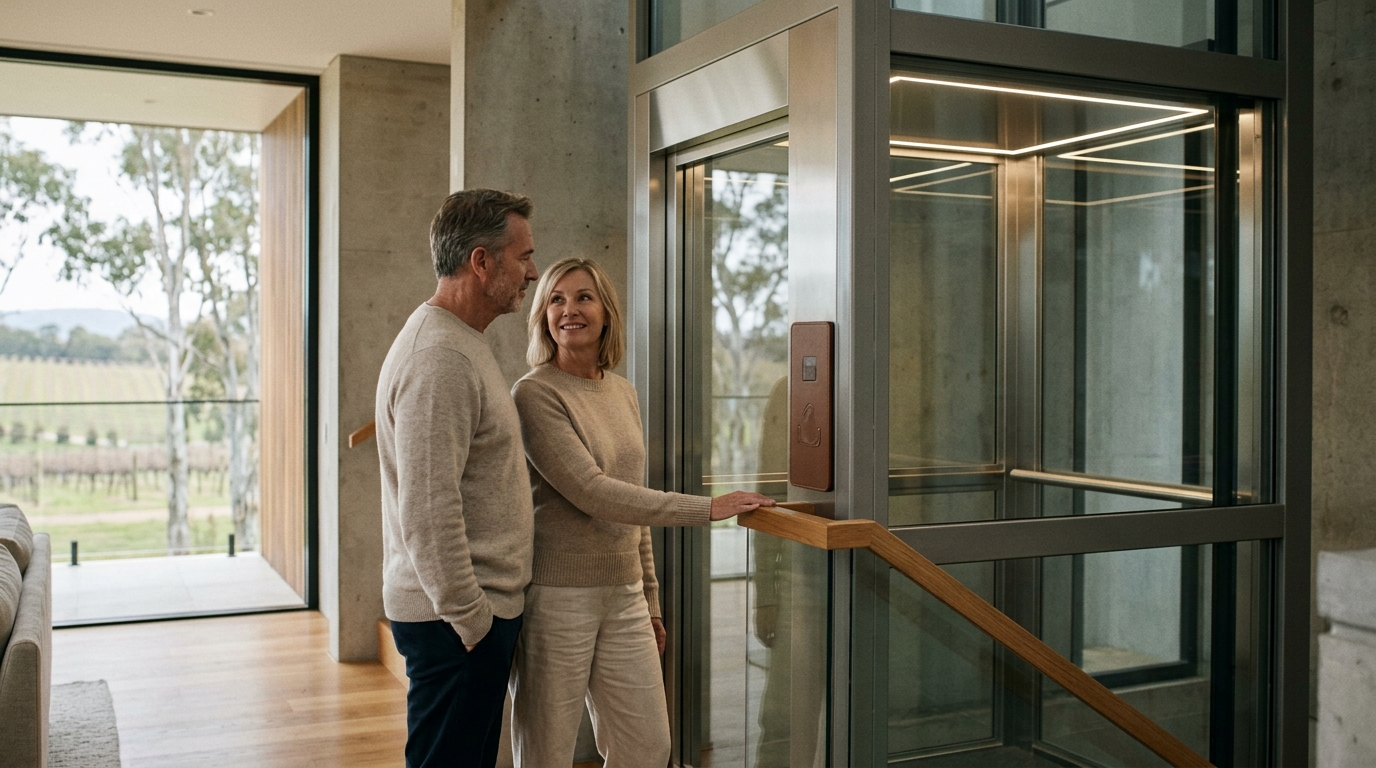
Whether you are building a new home in the Hunter Valley, upgrading a commercial property in Newcastle, or adding accessibility to an existing multi-storey structure, understanding the true cost of lift installation is essential for sound budgeting. Prices vary enormously depending on the type of lift, the number of floors served, and whether you are building new or retrofitting — and the difference can be tens of thousands of dollars.
This guide breaks down every cost category so you can plan your project with confidence, whether it is a compact residential elevator or a full-scale commercial passenger lift.
Residential Lift Costs at a Glance
For homeowners across Australia, the most common question is straightforward: how much will a home lift actually cost? The answer depends on your requirements, but here are the realistic price bands for 2026.
Entry-Level and Compact Lifts
Compact screw-driven lifts represent the most affordable starting point for residential installations. These space-efficient systems suit townhouses, duplexes, and smaller multi-level homes where footprint is limited. They require minimal structural modification and no dedicated machine room.
- Price range: $31,000–$40,000 for a two-stop system
- Best for: Urban homes with limited space, basic two-floor accessibility
Mid-Range Home Lifts
All-electric traction lifts and standard hydraulic models form the middle tier of the market. These deliver quieter operation, higher load capacities, and more finish options.
- All-electric traction lifts: From approximately $42,000 + GST for a two-stop unit
- Hydraulic lifts: Typically $45,000–$55,000 for a two-stop configuration
Premium Residential Elevators
High-end home lifts with automatic sliding doors, glass panels, designer finishes, and multi-stop configurations sit at the top of the market. These are often architectural features as much as functional equipment.
- Price range: $60,000–$110,000+
- Includes: Premium cab finishes, smart controls, three or four floor stops
The Total Installed Cost Picture
The lift unit price is only part of the equation. Your total project budget should also account for:
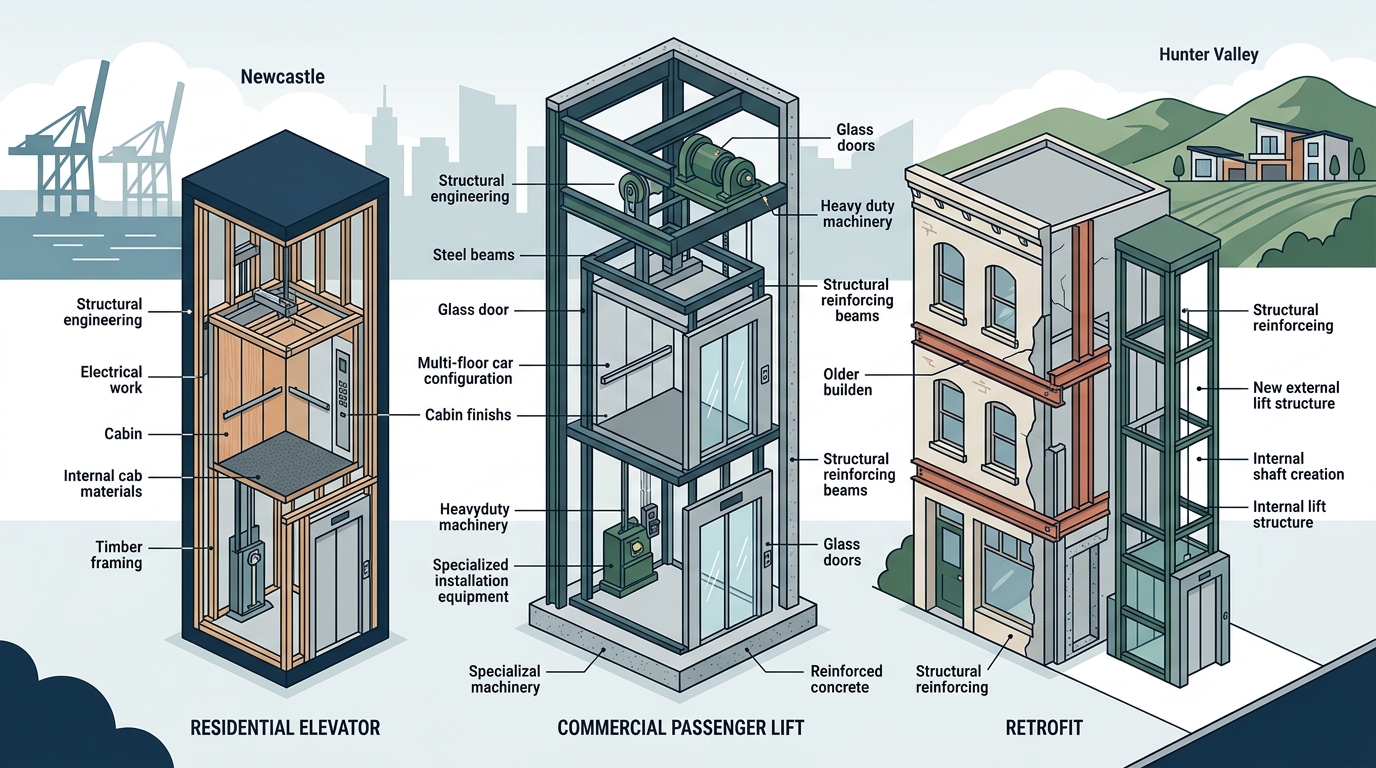
- Builder’s work: Shaft construction, pit preparation, and structural modification — typically $5,000–$20,000
- Electrical upgrades: Dedicated circuits or backup power supply
- Council approvals and inspections: Generally $1,000–$2,500
- Contingency margin: Industry experts recommend allowing 20–30% extra for unforeseen expenses such as construction changes or local approvals
When all associated costs are factored in, the true cost of a residential lift project can sit 10–15% above the sticker price of the unit itself. For retrofit projects specifically, total costs including all construction typically range between $60,000 and $100,000 AUD + GST.
Commercial Lift Installation Costs
Commercial elevator projects operate on an entirely different scale. Compliance with Australian standards (AS 1735) and Disability Discrimination Act (DDA) requirements establishes a higher baseline cost, and multi-storey installations compound expenses quickly.
Baseline Commercial Pricing
A basic two-level DDA-compliant commercial lift starts from around $50,000 + GST. For most office and retail environments, commercial elevators are priced between $50,000 and $100,000 per landing to install, excluding operation and ongoing maintenance costs.
Factors That Drive Commercial Costs Higher
- Number of landings: Each additional floor requires landing doors, extended shaft construction, and more complex control systems
- Speed requirements: Faster lifts demand more sophisticated braking, guide-rail, and motor systems
- Building conditions: Older buildings with limited shaft space or requiring structural reinforcement increase complexity significantly
- DDA compliance: All commercial lift cabins must meet minimum internal dimensions of 1,100 mm wide × 1,400 mm deep
- Travel distance: Standard inter-floor travel is approximately 4 m; distances exceeding 5 m incur additional costs
Cost Comparison by Lift Type
| Lift Type | Typical 2-Stop Cost (AUD) | Best Application | Key Consideration |
|---|---|---|---|
| Compact / Screw-Driven | $31,000–$40,000 | Small homes, retrofits | No machine room needed |
| All-Electric Traction | $42,000–$55,000 | New builds, energy-conscious homes | Lowest running costs |
| Hydraulic | $45,000–$55,000 | Heavy loads, larger homes | Requires pit and machine room |
| Pneumatic Vacuum | $50,000–$70,000 | Architecturally striking spaces | Premium aesthetic, limited capacity |
| Commercial Passenger | $50,000–$100,000 per landing | Offices, retail, healthcare | DDA compliance mandatory |
New Build vs. Retrofit: The Cost Difference
One of the most significant variables in lift installation pricing is whether the lift is being incorporated into a new construction or added to an existing structure.
New Build Installation
Incorporating a lift during new home construction is substantially cheaper because the shaft, pit, and electrical provisions can be factored into architectural plans from the outset. Installation labour for a new-build home lift typically costs between $4,000 and $8,000.
Retrofit Installation
Retrofitting a lift into an existing home is considerably more complex. It often requires cutting through floors, reinforcing walls, rerouting plumbing or electrics, and constructing a new shaft. Retrofit installation costs alone run between $12,000 and $40,000, and the total project cost including all civil works frequently lands between $60,000 and $100,000 AUD + GST.
Approximately 60–70% of home lift enquiries across Australia are for retrofit projects, which underscores how common — and how important to budget for — these additional costs are.
Seven Factors That Change Your Final Price
- Number of stops: Each additional floor adds $5,000–$10,000 in materials, wiring, and safety systems
- Cabin size and load capacity: Larger cabins accommodating wheelchairs, scooters, or multiple passengers cost more due to increased engineering requirements
- Drive system technology: Hydraulic, traction, screw-driven, and pneumatic systems each carry different price points and ongoing running costs
- Customisation and finishes: Glass panels, premium flooring, touchscreen interfaces, and designer lighting can add $3,000–$20,000 to the base price
- Indoor vs. outdoor placement: Outdoor lifts require additional weatherproofing, insulation, and structural supports, increasing costs
- Floor material (for retrofits): Timber mid-floors are easier and cheaper to modify than concrete slabs
- Location and labour rates: Costs vary across states, with urban labour rates typically higher than regional areas
Ongoing Costs You Must Budget For
The purchase and installation price is just the beginning. Responsible lift ownership requires budgeting for several recurring expenses.
Annual Maintenance
Regular servicing is essential for safety and smooth operation. For residential lifts, annual maintenance typically costs between $300 and $1,500 depending on the lift type and service package selected. Commercial lifts require more frequent servicing, with annual contracts often running higher.
Energy Consumption
Modern lifts are surprisingly energy-efficient. All-electric models run on standard single-phase 10-amp power and consume electricity only during operation. Hydraulic lifts tend to draw significantly more power, sometimes requiring a multi-phase supply of up to 40 amps.
Future Modernisation
Commercial elevators are typically 25+ year assets. Equipment designed to last 20–25 years usually requires a controls modernisation around year 15–20, with more comprehensive work as components age. Planning for this lifecycle cost is critical for commercial building owners.
How a Lift Adds Value to Your Property
A well-installed lift is not just a functional asset — it is a value-adding investment. Quality home lifts can increase Australian property resale prices by 10% to 25% or more. Some industry reports suggest a premium lift installation can add up to three times its cost in market value, particularly in areas with ageing populations or multigenerational households.
Beyond resale value, lifts support the growing Australian trend of ageing in place, allowing homeowners to remain comfortably in multi-storey homes as mobility needs change. This future-proofing benefit is increasingly factored into property valuations.
Practical Tips to Reduce Your Lift Installation Cost
- Plan during construction: Incorporating a lift shaft into new-build plans avoids expensive retrofit work later
- Match technology to need: A compact screw-driven lift may meet all your requirements at half the cost of a hydraulic system
- Get multiple quotes: Pricing varies significantly between suppliers — always compare at least three comprehensive quotes
- Assess total lifetime cost: Consider energy efficiency, maintenance contracts, and servicing frequency, not just the purchase price
- Check eligibility for funding: If you are installing a lift for accessibility or medical reasons, you may be eligible for financial support through the NDIS or other programs
- Prioritise safety compliance: Ensure any lift meets Australian AS 1735 standards for long-term reliability and insurance coverage
Key Takeaways
- Standard residential lift installation in Australia costs between $25,000 and $60,000, with premium systems exceeding $110,000
- Commercial lifts range from $50,000 to $100,000+ per landing
- Retrofitting into an existing building adds $3,000–$15,000 in civil works on top of unit and installation costs
- The number of stops is the single biggest cost driver — each additional floor adds $5,000–$10,000
- Annual maintenance runs $300–$1,500 for residential lifts
- Always budget a 20–30% contingency margin for unforeseen expenses
- Quality lifts can boost property value by 10–25% or more
Why Choose Newcastle Lift Services
At Newcastle Lift Services, we bring deep local expertise to every lift project across the Hunter Valley, Newcastle, and the Central Coast. Whether you need a compact residential lift for an existing home, a multi-stop elevator for a new commercial development, or ongoing maintenance for your current system, our team provides transparent pricing, AS 1735-compliant installations, and responsive after-sales support. Contact us today for a no-obligation quote tailored to your specific project requirements.
Frequently Asked Questions
How much does a residential lift cost in Australia in 2026?
Standard home lifts typically cost between $25,000 and $60,000 installed. Compact screw-driven models start near $31,000, while premium multi-stop systems with designer finishes can exceed $110,000. Total project costs for retrofits — including all building work — commonly range from $60,000 to $100,000 AUD + GST.
How much does a commercial lift cost to install?
Commercial elevator installation generally ranges from $50,000 to $100,000 per landing. A basic two-level DDA-compliant lift starts from around $50,000 + GST. Multi-storey installations with higher speed requirements and premium finishes can cost significantly more.
What factors affect lift installation cost the most?
The number of floors or stops has the greatest impact, with each additional level adding $5,000–$10,000. Other major factors include the lift drive system, cabin size and capacity, level of customisation, and whether the project is a new build or retrofit.
Is it cheaper to install a lift during construction or retrofit later?
Installing during new construction is significantly cheaper. New-build lift installation costs $4,000–$8,000, while retrofitting into an existing home can cost $12,000–$40,000 for installation alone, before accounting for structural modifications.
What are the ongoing costs of owning a lift?
Annual maintenance for residential lifts ranges from $300 to $1,500. Energy costs are generally modest as most modern lifts only draw power during operation. Commercial lifts require more frequent servicing and higher-value maintenance contracts, plus eventual modernisation around year 15–20.